
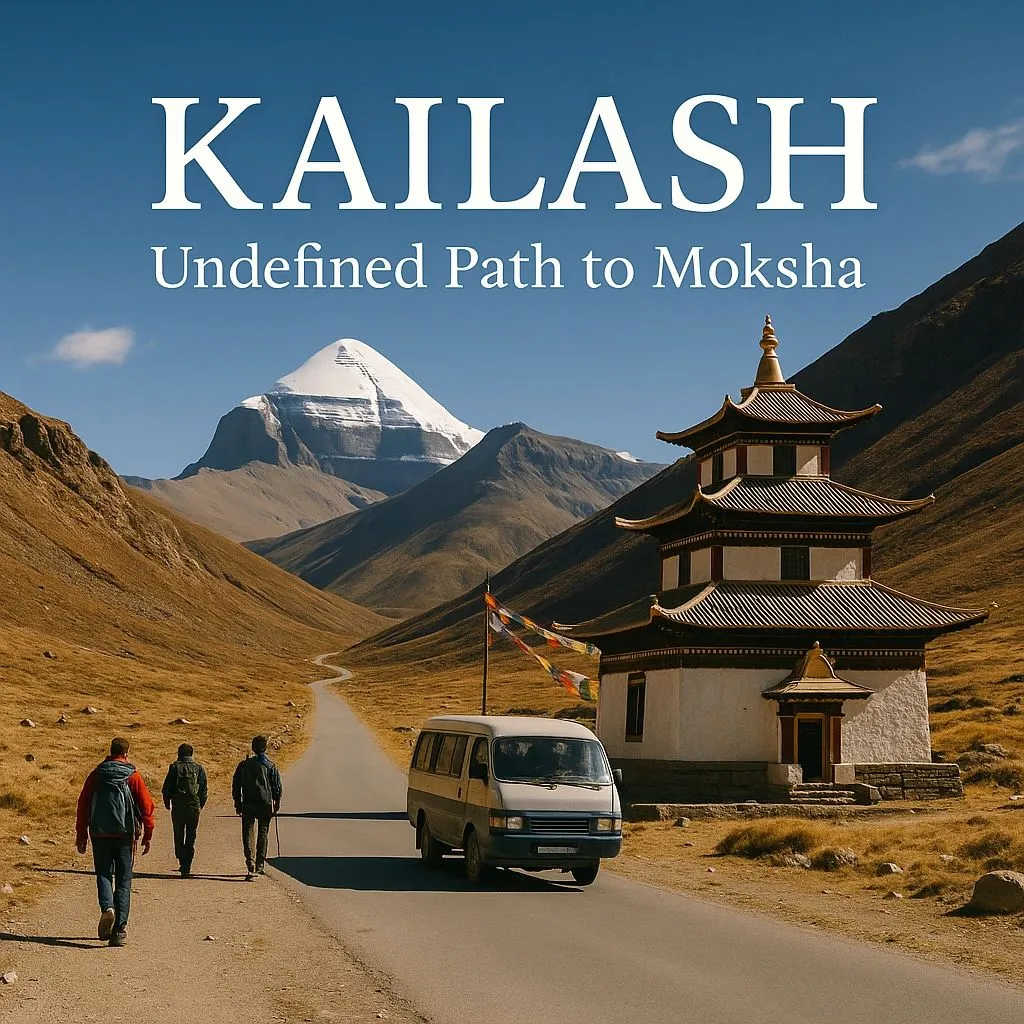
For centuries, reaching Mount Kailash meant an arduous overland journey across some of the most difficult terrain in the Himalayas. Today, roads, organised routes and expanding infrastructure have transformed access to one of the world’s most sacred mountains. The change has made the pilgrimage possible for far greater numbers of people, while raising difficult questions about ecology, development and the meaning of a journey once defined by hardship.
A Mountain Sacred to Four Traditions
Mount Kailash rises to 6,638 metres in the remote western reaches of Tibet. It is revered across four major religious traditions. For Hindus it is the abode of Lord Shiva. Buddhists associate it with the mythical Mount Meru, the centre of the universe, and with important tantric deities. Jains regard it as the place where the first Tirthankara, Rishabhanatha, attained liberation. Followers of the Bon tradition, Tibet’s pre-Buddhist faith, also hold the mountain as a powerful spiritual centre.
Unlike most sacred peaks, Kailash is not climbed. Pilgrims instead perform the kora—a circumambulation of roughly 52 kilometres around its base. The circuit typically takes three days on foot, though some complete it in a single day and others take far longer, progressing by full-body prostrations. Completing the kora is believed to purify the pilgrim and erase the sins of a lifetime. The nearby Lake Mansarovar forms an integral part of the sacred landscape.
Geography That Once Limited Access
The mountain’s isolation was long its defining feature. Situated on the high Tibetan plateau near the borders of India, Nepal and China, Kailash could be reached only after weeks of travel across high passes, river valleys and sparsely inhabited terrain. Weather, altitude and the absence of roads made the journey possible for only the most determined. For many communities in the Indian Himalaya, the pilgrimage remained a rare and life-defining undertaking.
This geographical remoteness helped preserve both the sanctity and the relative quiet of the site. It also meant that numbers remained small. Historical accounts suggest that even in the early twentieth century only limited numbers of pilgrims reached the mountain each year.
Colonial Encounters and Early Infrastructure
British colonial interest in the western Himalaya and Tibet brought new attention to the region. Surveyors and administrators mapped routes, recorded local traditions and, in some cases, encouraged pilgrimage as a means of fostering economic activity and influence along the borderlands. Early twentieth-century writings by colonial officials helped shape modern Indian understandings of Kailash as a major sacred destination.
Yet the mountain remained difficult to reach. Real transformation in access would come much later, through state-led road building and the gradual opening of regulated pilgrimage corridors.
Geopolitics and the Closing and Reopening of Routes
The mid-twentieth century brought sharp interruptions. After the 1962 Sino-Indian War, the border closed and Indian pilgrims lost access for nearly two decades. Limited pilgrimage resumed in 1981 following bilateral arrangements between India and China. Even then, numbers were tightly controlled, and access remained subject to diplomatic conditions.
Tensions along the border, including the 2020 Galwan clash, and the disruptions of the pandemic led to further suspensions. Official Indian yatras have been restarted in phases, with routes operating through Lipulekh Pass in Uttarakhand and Nathu La in Sikkim. Private operators also organise journeys via Nepal, subject to Chinese permits and quotas. Demand frequently exceeds the number of places available.
The result is a pilgrimage that is simultaneously spiritual and geopolitical. Access depends on visas, permits, bilateral agreements and the state of relations between neighbouring countries. Infrastructure built to support the yatra also serves broader strategic and connectivity purposes in a sensitive border region.
Roads, Tourism and Ecological Pressure
In recent decades, road construction on both the Indian and Tibetan sides has dramatically shortened travel times and reduced the amount of trekking required. What once demanded weeks of walking can now be completed with significant stretches by vehicle. Hotels, homestays and tourism services have multiplied around key points on the route.
This increased accessibility has brought clear benefits: older pilgrims and those with limited physical capacity can now undertake a journey that was previously impossible for them. Local economies along the routes have gained from the flow of visitors.
At the same time, the changes have intensified pressure on a fragile high-altitude environment. Road building involves blasting and alteration of slopes. Growing numbers of visitors increase waste, water demand and disturbance to alpine ecosystems. Critics argue that the insistence on making every remote sacred site easily reachable risks undermining the very qualities—silence, difficulty, remoteness—that gave the pilgrimage its power.
Faith in a Changing Landscape
The spiritual significance of Kailash remains undiminished for the millions who revere it. Yet the character of the pilgrimage is evolving. Greater comfort and speed alter the experiential dimension of the journey. The physical ordeal that once tested resolve and marked the transition into sacred space is partially replaced by organised logistics and regulated schedules.
For indigenous communities living on the approaches to the mountain, the transformation raises additional questions about land use, cultural continuity and the costs of development that primarily serves outside visitors.
A Modern Pilgrimage at a Crossroads
Mount Kailash today stands at the intersection of ancient faith, modern infrastructure and international politics. Its status as a shared sacred site for multiple religions gives it unusual spiritual breadth. Its location at a geopolitical crossroads makes access contingent on diplomacy. The roads and facilities that have opened it to larger numbers of pilgrims simultaneously threaten the ecological and experiential qualities that sustained its mystique for centuries.
The central question is no longer simply how to reach Kailash. It is how to balance the legitimate desire of devotees to undertake the pilgrimage with the need to protect a fragile landscape and to preserve something of the austerity that long defined the journey. Faith brought generations of pilgrims across immense distances. Geography once limited their numbers. Geopolitics still governs their access. Development now determines the terms on which the sacred mountain is encountered. How these forces are reconciled will shape the future of one of the world’s most revered pilgrimages.
Read more – atechsslaash.com , BestMenuHub.com