
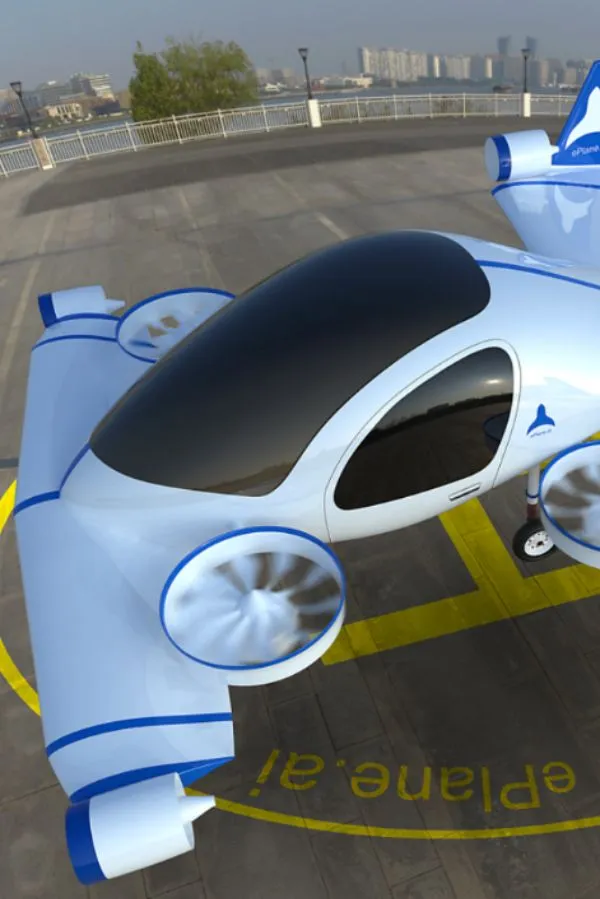
Anyone stuck in the daily gridlock of Mumbai, Bengaluru or Delhi has imagined a simpler escape: rising above the traffic and gliding across the city. What once belonged to science fiction is now taking concrete shape at the Indian Institute of Technology Madras. The ePlane Company’s e200X, a full-scale electric vertical take-off and landing aircraft, is designed as an air taxi that can also serve as an air ambulance or cargo carrier. At the heart of the project is a deliberate, multi-layered approach to safety.
Founder and technical lead Professor Satya Chakravarthy, an aerospace engineering faculty member at IIT Madras, has repeatedly emphasised that passenger confidence will depend on proven redundancy. The aircraft incorporates seven distinct layers of safety. Each layer is intended to protect occupants if the systems above it fail, creating a progressive defence against the most critical failure modes in electric flight.
Layer One: Independent Powertrain and Battery Systems
The first line of defence is the power architecture. Energy is distributed across independent battery packs rather than concentrated in a single source. If one pack develops a fault, it can be isolated without interrupting power to the rest of the aircraft. This design principle ensures that a localised electrical problem does not cascade into a total loss of propulsion or control. Continuous, stable power delivery forms the foundation on which every subsequent safety measure rests.
Layer Two: Distributed Electric Propulsion
The e200X uses a distributed electric propulsion system with ten independent motors arranged across two rotor sets. Six vertical rotors provide lift for take-off and landing, while four forward propellers handle cruise flight. Because the motors operate independently, the failure of any single motor does not compromise the aircraft’s ability to stay airborne. Thrust can be redistributed among the remaining units, allowing the vehicle to continue controlled flight. This architecture eliminates the classic single-point failure risk associated with traditional single-engine or dual-engine designs that rely on fewer, larger powerplants.
Layer Three: Independent Lift and Cruise Configuration
Unlike some competing electric vertical take-off and landing concepts that use tilting rotors or complex mechanical linkages, the e200X keeps its propulsion systems fixed and functionally separate. The vertical lift system and the forward cruise system operate independently of each other. A problem that arises during the vertical phase cannot propagate into the cruise system, and a cruise-phase issue cannot disable the ability to land vertically. This physical and functional separation adds another layer of isolation between different flight regimes.
Layer Four: Aerodynamic Lifting Surfaces and Glide Capability
Should the aircraft experience a complete loss of power, the wing design comes into play. The e200X is engineered with a glide ratio of approximately 10, which means that for every unit of altitude lost, it can travel roughly ten units of distance forward. This performance exceeds that of a conventional light aircraft such as a Cessna in similar conditions. The ability to glide gives the pilot or autonomous systems time and distance to select a suitable landing area rather than descending vertically under emergency conditions alone.
Layer Five: Ballistic Parachute and Impact-Absorbing Systems
If the aircraft is beyond effective gliding range or faces a more severe emergency, a ballistic parachute system can be deployed. Working in conjunction with impact-absorbing inflatables, the parachute is designed to slow the descent and bring the vehicle to the ground in a controlled manner. The structure itself is engineered to remain intact through this process, prioritising the preservation of the cabin volume and the occupants inside it.
Layer Six: Crash-Resistant Fuselage
The airframe is built to withstand substantial impact loads. The fuselage is designed to tolerate forces of up to 16G. This structural robustness provides a final physical barrier that absorbs and dissipates energy in the event of a hard landing or impact, further protecting the internal cabin and its occupants. Few other developers in the electric vertical take-off and landing space have publicly emphasised a comparable structural standard.
Layer Seven: Crashworthy Seating and Restraint Systems
Closest to the passenger is the seating system. Each seat incorporates a four-point harness and an energy-absorbing structure, including a crash cushion beneath the seat. These features are intended to manage the residual forces that reach the occupant after the outer layers have done their work. By combining restraint with progressive energy absorption, the design aims to keep peak loads on the human body within survivable limits.
Design Philosophy and Operational Context
The seven layers reflect a consistent engineering philosophy: assume that individual components can fail and ensure that no single failure leads to catastrophe. Professor Chakravarthy has stressed the need to demonstrate extremely low failure probabilities across critical systems, consistent with the rigorous standards expected in aviation certification. The aircraft’s compact footprint is intended to allow operations from existing rooftops and helipads, reducing the need for entirely new infrastructure while still prioritising safety over densely populated areas.
The e200X prototype has a gross take-off weight in the range of two to 2.2 tonnes, a claimed range of roughly 100 to 110 kilometres on a single charge, and a cruise speed around 160 kilometres per hour. In its passenger configuration it is designed to carry one pilot and two passengers. Variants are also planned for air ambulance use, carrying a patient and paramedic, and for cargo.
Building Public and Regulatory Confidence
Safety in urban air mobility is not only a technical challenge but also a matter of public trust and regulatory acceptance. By articulating a clear, sequential set of protective measures, the ePlane team is attempting to make the aircraft’s safety case transparent. Each layer is designed to activate if the preceding ones are compromised, creating a cascade of protection rather than reliance on any single system.
As the full-scale prototype moves through ground testing and toward flight trials, the focus will remain on validating these redundancies under controlled conditions. Only after the systems have demonstrated their ability to handle failure scenarios will the path to passenger-carrying operations become clearer. For a country whose cities are defined by congestion, the promise of rising above the traffic is compelling. The seven layers of safety built into the IIT Madras-linked ePlane represent a serious attempt to ensure that the journey is as secure as it is transformative.
Read more – marathibhashaa.com