
A hidden but increasingly visible economy operates alongside Bollywood’s official publicity machinery. Paid trolling — the organised purchase of negative comments, coordinated smear posts, mass reporting and narrative attacks — has become a tool used to damage star reputations, influence film reception and settle professional scores. Industry figures speaking on the subject describe campaigns that can cost anywhere from a few thousand rupees to several crores, depending on scale and duration.
How the System Works
According to public-relations professionals and other industry members, the services are modular. Mass reporting of an account or post with the aim of getting it restricted or removed can be arranged for amounts in the thousands of rupees. A more visible coordinated attack involving roughly a thousand posts or comments is commonly quoted around one lakh rupees. Sustained campaigns that run for weeks, combine multiple platforms and aim to shift broader public perception are said to command far higher fees, sometimes exceeding fifty lakh rupees and, in high-stakes cases, moving into crore figures.
These operations typically rely on networks of meme pages, anonymous handles, bot-assisted amplification and, at times, influencers who are supplied with talking points. The goal is rarely a single viral insult. It is repetition — enough negative volume that ordinary users begin to treat the manufactured sentiment as organic consensus.
Who Gets Targeted
Several prominent actors have faced waves of unusually synchronised criticism that industry observers link to paid activity. Alia Bhatt has been the subject of intense online hostility around film releases and personal milestones. Ranbir Kapoor has encountered sharp attacks timed with project announcements, including recent trailer reactions. Deepika Padukone has faced prolonged negative commentary after taking public positions on working conditions. Kriti Sanon saw a brand advertisement withdrawn after it was turned into sustained rage-bait. Other names frequently cited in the same context include Kartik Aaryan and Varun Dhawan.
The triggers vary. Sometimes the campaign coincides with a competing film’s release. Sometimes it follows an actor’s public statement, a brand association or simply a period of professional success that rivals wish to undercut. In each case the pattern described by those affected is similar: sudden spikes in identical insults, coordinated hashtags and a volume of abuse that exceeds normal audience reaction.
Impact on Films and Careers
The commercial consequences can be tangible. Negative narratives seeded before or immediately after a release can dampen opening-day sentiment, discourage casual viewers and complicate marketing efforts. Brand partners monitor social sentiment closely; sustained toxicity has led to campaigns being paused or cancelled. Casting decisions are not immune either. When an actor becomes associated with constant controversy, even if the controversy is engineered, some producers grow cautious.
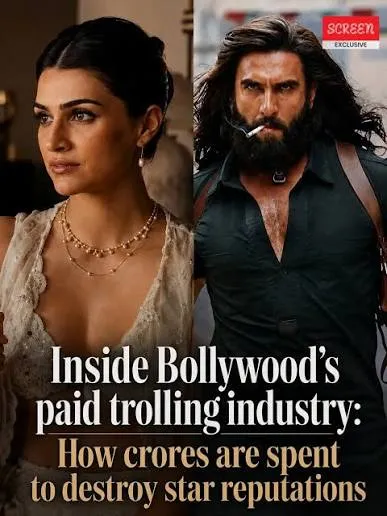
Beyond the professional sphere lies the personal cost. Actors and their families describe the mental strain of reading continuous abuse, much of it personal and often extending to relatives. Filmmakers have noted that the same machinery used against stars is sometimes turned on critics who publish unfavourable reviews, creating an atmosphere in which honest appraisal carries a risk of organised harassment.
An Open Secret with Limited Accountability
Many in the industry acknowledge that paid negative campaigning exists, yet few are willing to name specific agencies or clients on the record. The work is usually commissioned through intermediaries, paid in cash or through opaque digital channels, and executed by accounts that can be discarded and replaced. Platforms struggle to distinguish coordinated inauthentic behaviour from genuine public anger, especially when the content carefully avoids clear calls to violence or illegal activity.
Some actors have begun speaking more openly about the problem. A few have publicly labelled particular waves of abuse as paid. Others have chosen silence, calculating that responding only amplifies the attack. Public-relations teams, meanwhile, spend increasing portions of their budgets on defensive monitoring and counter-narratives, adding another layer of cost to an already expensive publicity ecosystem.
Why the Practice Persists
The incentives are straightforward. In an attention-driven market, damaging a rival’s reputation or a competing film’s prospects can appear cheaper and faster than building one’s own positive momentum. Social-media algorithms reward engagement, and outrage generates engagement efficiently. As long as the financial and reputational returns outweigh the limited risk of exposure, the market for these services continues.
There is also a cultural dimension. Fan armies, already highly mobilised, can be nudged by a relatively small paid core into larger organic participation. Once a negative frame takes hold, genuine disappointment or rivalry supplies additional volume at no extra cost to the original paymaster.
The Larger Cost to the Industry
Paid trolling corrodes trust on multiple levels. Audiences become unsure whether the criticism they see reflects real opinion or purchased noise. Actors grow wary of public engagement. Marketers find it harder to read authentic sentiment. Over time, the constant presence of manufactured hostility risks making the entire online conversation around Hindi cinema feel less reliable.
Some within the industry argue that greater transparency, clearer platform enforcement against coordinated inauthentic behaviour, and a collective refusal to commission such campaigns are necessary. Others believe the practice is now too embedded and too useful to certain players to disappear quickly.
What remains clear is that the phenomenon is no longer dismissed as paranoia. From modest sums spent on comment floods to multi-lakh or crore-level sustained assaults, money is regularly changing hands to shape how stars and films are perceived. The reputational damage is real, the commercial effects are measurable, and the human toll on those targeted continues to mount. Until stronger norms or enforcement mechanisms emerge, paid trolling is likely to remain one of Bollywood’s most corrosive open secrets.
Read more – Blessingread.com , pfptrends.com