
A major change in India’s direct tax system took effect on 1 April 2026. The old Income-tax Act of 1961 has been replaced by the Income-tax Act, 2025. This is not a small amendment but a complete rewrite of the main law that governs how income tax is calculated, collected, and administered. The goal is to make the rules clearer, shorter, and easier for ordinary taxpayers to understand while keeping the basic tax structure intact. Here is a straightforward explanation of what has changed and what it means in practical terms.
Why a New Tax Law Was Introduced
The previous law had grown complex over more than sixty years through countless amendments. It contained hundreds of sections, overlapping provisions, and language that many people found difficult to follow. The new Act reduces the number of sections significantly and reorganises the content into fewer chapters. The language has been simplified, and many provisions have been consolidated so that related rules appear together. Officials have described the change as an effort to create a more modern and reader-friendly tax code without increasing the tax burden.
Key Structural Changes
One of the most noticeable differences is the introduction of a single “Tax Year.” Under the old system, people had to deal with both a “Previous Year” (the year in which income was earned) and an “Assessment Year” (the following year in which tax was assessed). From 1 April 2026 onwards, the law uses only the concept of a Tax Year, which runs from 1 April to 31 March—the same as the financial year. This removes one layer of confusion for most individual taxpayers.
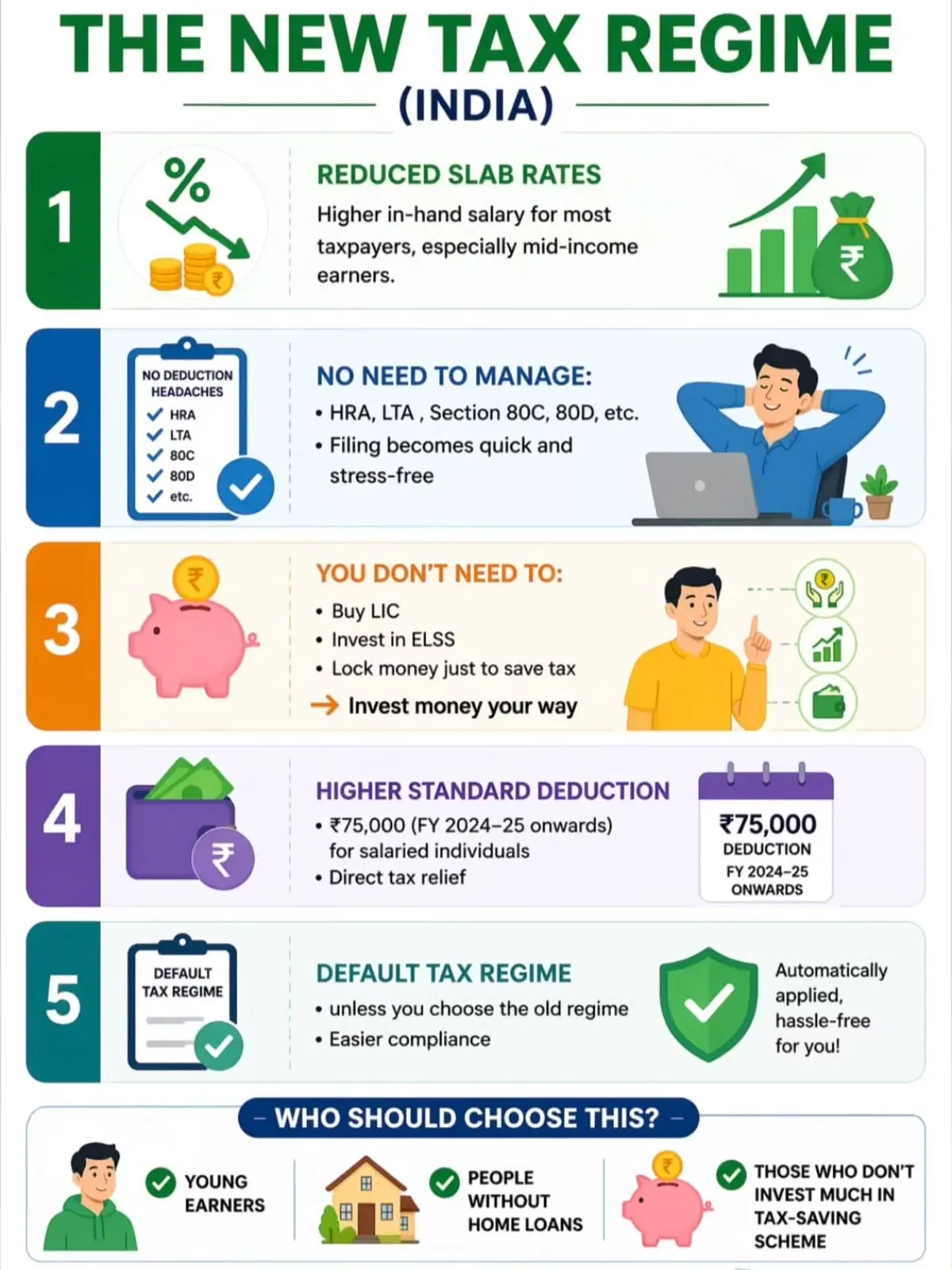
The new law does not create any new taxes or raise existing rates. Tax slabs, surcharge, and cess remain the same as before. The new tax regime continues to be the default option for individuals, Hindu Undivided Families, and certain other entities. Taxpayers can still choose the old regime if they prefer to claim the deductions and exemptions available under it, provided they follow the prescribed process.
What Stays the Same for Most People
For salaried employees and ordinary individual taxpayers, the day-to-day experience of paying tax changes less than the legal structure. Income continues to be taxed under the familiar heads—salary, house property, business or profession, capital gains, and other sources. The choice between the new regime (lower rates, fewer deductions) and the old regime (higher rates but more deductions) remains available. Employers will still deduct tax at source, and individuals will still file returns.
Forms and procedures are being updated and, in some cases, consolidated to match the new law. The overall aim is to reduce the compliance burden rather than add new requirements.
Practical Impact on Taxpayers
Because the new Act applies to income earned from 1 April 2026 onwards, the first returns under the fully new framework will relate to the financial year 2026-27. Returns for earlier years continue to be governed by the old law and the transitional rules that have been put in place.
Taxpayers should expect clearer definitions and a more logical arrangement of rules when they refer to the law or receive guidance. Those who rely on tax software, chartered accountants, or online portals will see updated forms and utility tools that reflect the new structure. People who were already comfortable with the previous system will find that the core calculations for salary income, standard deductions, and common exemptions remain familiar.
Transition and Continuity
The old Act stands repealed from 1 April 2026, but transitional provisions ensure that pending assessments, appeals, and other proceedings started under the 1961 law can continue without disruption. This prevents a sudden break in ongoing cases. Authorities have issued guidance and FAQs to help taxpayers and professionals understand how the two laws interact during the changeover period.
What Taxpayers Should Do
Most individuals do not need to take immediate special action beyond staying informed. When the time comes to file the return for the first Tax Year under the new Act, the updated forms and utilities will guide the process. Those who usually choose between the old and new tax regimes should continue to compare both options based on their deductions and income profile, as the fundamental choice remains.
It is useful to keep track of official communications from the tax department, especially regarding any updated forms, new rule numbers, or clarifications on specific provisions. People with more complex affairs—business income, capital gains, foreign assets, or multiple sources of income—may benefit from professional advice during the first year of the new law to ensure correct reporting.
Broader Purpose of the Change
The replacement of the 1961 Act is part of a longer effort to simplify tax administration, reduce disputes arising from unclear language, and make compliance less time-consuming. By shortening the law, consolidating related rules, and adopting clearer drafting, the new framework aims to help both taxpayers and tax officers work with greater certainty.
In simple terms, the “new tax rule” that took effect in April 2026 is the complete replacement of the old Income-tax Act with a streamlined version. It does not raise tax rates or invent new taxes. Instead, it reorganises and simplifies the existing system, introduces the single concept of a Tax Year, and keeps the new tax regime as the default while preserving the option to use the old regime. For the average taxpayer, the most important points are that the familiar slab structure continues, the choice between regimes remains, and the legal language governing everyday tax matters has been made easier to follow. Staying aware of the updated forms and any official clarifications will help ensure a smooth transition as the new law becomes the standard reference for income tax in India.
Read more – casinopeers.com