
NASA’s Nancy Grace Roman Space Telescope is preparing for launch with a distinctive human element alongside its advanced scientific instruments. A compact memory card containing more than 1.35 million names submitted by people around the world has been installed on the observatory. When the telescope begins its journey to a distant vantage point in space, those names will travel with it, turning a major astrophysics mission into a shared symbolic voyage.
A Public Invitation Becomes Part of the Mission
In the lead-up to launch, NASA invited members of the public to submit their names for inclusion on the Roman Space Telescope. The final total reached 1,350,144 entries. The list draws from participants across many countries and includes the names of astronauts assigned to upcoming Artemis missions. On July 27, technicians at NASA’s Kennedy Space Center carefully secured the memory card as part of a commemorative plaque attached to the spacecraft.
The card itself is small, yet it represents a deliberate effort to connect a broad global audience with one of the agency’s flagship observatories. Once launched, the names will travel roughly one million miles from Earth to the Sun-Earth Lagrange point L2, a gravitationally stable region where the telescope will conduct its observations. From that location, the observatory will survey the cosmos while carrying this personal record of human interest in exploration.
The Science Mission Behind the Names
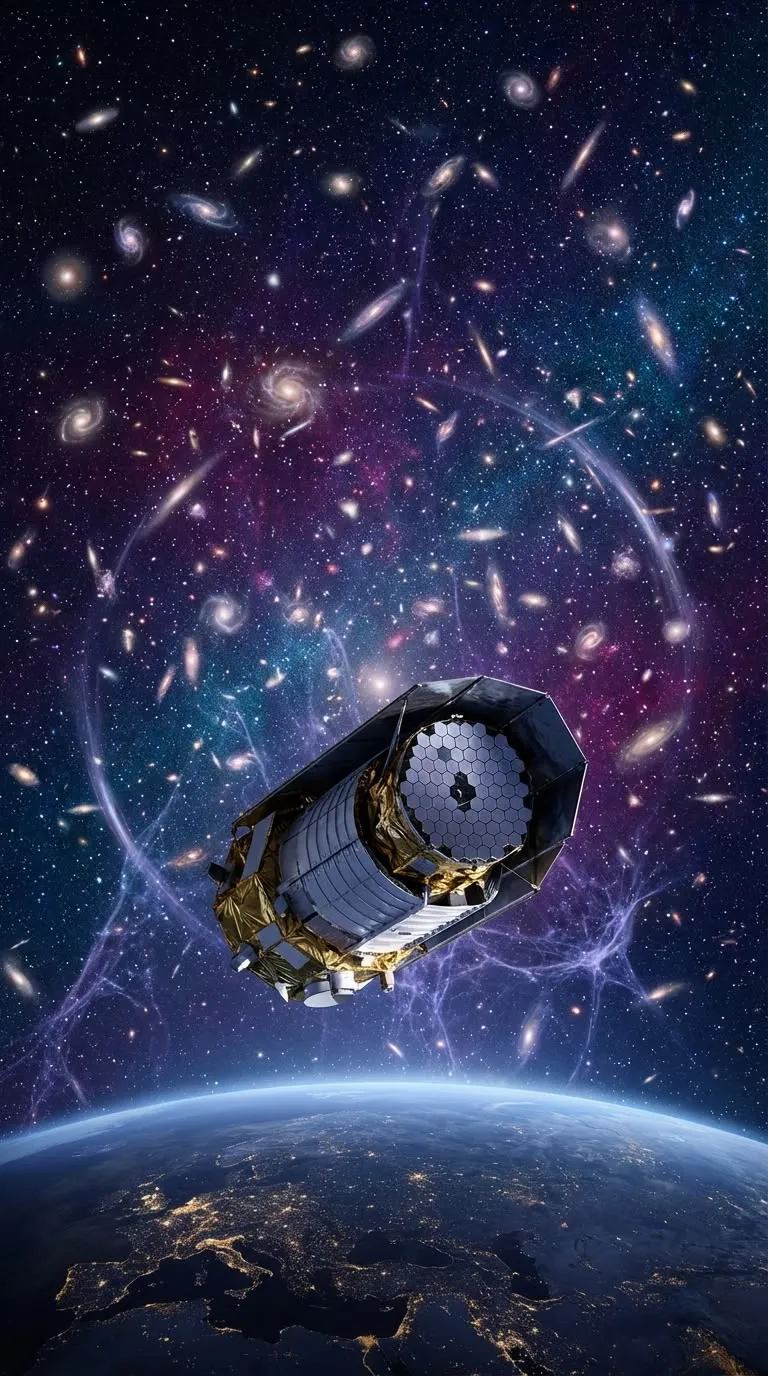
The Roman Space Telescope is designed to address some of the most significant questions in modern astrophysics. Named in honor of NASA’s first chief of astronomy, Nancy Grace Roman, the mission will investigate the nature of dark energy, the mysterious force driving the accelerated expansion of the universe. It will also conduct a wide-ranging census of stars and galaxies and search for distant worlds beyond our solar system.
The telescope’s primary mirror measures 2.4 meters across, the same diameter as the Hubble Space Telescope’s main mirror, yet it is engineered to be far lighter. Its standout capability is an exceptionally wide field of view. The Wide Field Instrument, a 300-megapixel camera sensitive to visible and near-infrared light, can image an area of sky approximately 100 times larger than Hubble’s cameras in a single frame while maintaining comparable sharpness. This panoramic reach will allow astronomers to map vast regions efficiently and gather statistical samples of billions of galaxies and hundreds of millions of stars.
A second instrument, the Coronagraph, is designed to block the intense glare of stars so that much fainter nearby objects can be detected. This technology demonstration aims to image planets that are extremely dim relative to their host stars, advancing techniques for studying exoplanets directly. Complementary observations using gravitational microlensing are expected to reveal thousands of additional distant worlds, including those that may be difficult to detect by other methods.
Launch Plans and Destination
NASA and SpaceX are targeting a launch window beginning no earlier than late August 2026. The observatory is scheduled to lift off aboard a Falcon Heavy rocket from Launch Complex 39A at Kennedy Space Center. After separation from the launch vehicle, the telescope will travel to its operational orbit around the Sun-Earth L2 point. At that distance, the combined gravitational influences of the Sun and Earth create a stable environment that offers a clear view of the universe while helping keep the instruments cold and thermally stable.
From L2, Roman will operate for a planned primary mission of five years, with the possibility of extension. Its rapid survey speed and large field of view are expected to generate an enormous volume of data, enabling both targeted investigations and broad statistical studies of cosmic structure and evolution.
Why the Names Matter
Including public names on a spacecraft is not a new practice for space agencies, but it carries particular resonance for a mission of this scale. The Roman telescope will spend years collecting light that left distant galaxies billions of years ago. By placing a digital record of more than a million individual names on the same vehicle, the project creates a tangible link between everyday people and the scientific endeavor. The presence of Artemis crew names further ties the observatory to NASA’s broader exploration goals, connecting deep-space astronomy with the agency’s plans for human activity beyond low Earth orbit.
The gesture also underscores the collaborative character of modern space science. Large observatories depend on international partnerships, shared data, and public support. Inviting people to place their names on the telescope is one practical way of acknowledging that wider community of interest.
Looking Ahead
Once operational, the Nancy Grace Roman Space Telescope is expected to transform several fields of astronomy. Its ability to survey huge swaths of sky quickly will accelerate the mapping of large-scale structure, refine measurements related to dark energy, and expand the known population of exoplanets. The data will be made available to the scientific community, continuing a tradition of open access that Nancy Grace Roman herself championed during her career.
At the same time, the small memory card carrying 1.35 million names will remain a quiet passenger on the journey. It will not contribute to the scientific measurements, yet it adds a human dimension to the mission. In an era when space exploration can sometimes feel remote from daily life, the inclusion of so many individual names serves as a reminder that curiosity about the universe is widely shared.
The Roman Space Telescope therefore launches with a dual identity: a sophisticated observatory built to answer fundamental questions about the cosmos, and a vessel carrying a collective expression of human participation. When it reaches its distant observing post, both the advanced instruments and the simple list of names will have completed the same million-mile voyage from Earth.
Read more – cbdnets.com