
Quantum computing is one of the most advanced and exciting areas of modern technology. While traditional computers have transformed the way people work, communicate, and solve problems, quantum computers aim to handle certain complex challenges that are difficult or impossible for conventional machines.
The concept of quantum computing may sound complicated because it is based on principles of quantum physics, a branch of science that explains how extremely small particles behave. However, understanding the basic idea does not require advanced scientific knowledge. At its core, quantum computing is about using the unique properties of quantum particles to process information in a completely different way from traditional computers.
From medical research and climate modelling to cybersecurity and artificial intelligence, quantum computing has the potential to create significant changes across various industries. This beginner-friendly guide explains what quantum computing is, how it works, its benefits, challenges, and future possibilities.
What Is Quantum Computing?
Quantum computing is a type of computing technology that uses the principles of quantum mechanics to process information. Unlike traditional computers that use bits as the smallest unit of data, quantum computers use quantum bits, commonly known as qubits.
A traditional computer represents information using bits that exist in one of two states: 0 or 1. These binary systems power everything from smartphones and laptops to large data centres.
Quantum computers work differently because qubits can represent information in multiple states due to quantum properties. This allows quantum computers to approach certain calculations in a new way and potentially solve problems much faster than traditional computers.
However, quantum computers are not designed to replace everyday computers. Instead, they are expected to work alongside traditional systems to solve highly complex problems.
Understanding Qubits: The Foundation of Quantum Computing
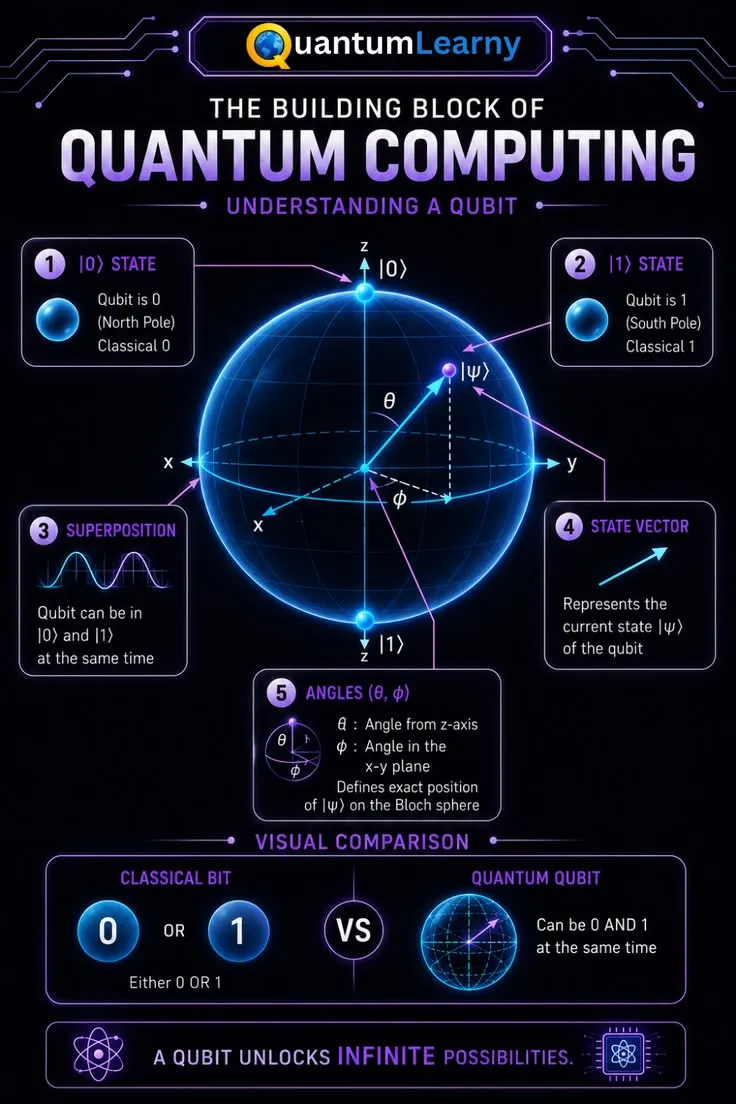
The most important element of quantum computing is the qubit. A qubit is the quantum version of a traditional computer bit.
In classical computing, a bit can only have one value at a time, either 0 or 1. A qubit can exist in a combination of states through a quantum phenomenon known as superposition.
This ability allows quantum computers to process multiple possibilities simultaneously in certain calculations. The more qubits a quantum computer has, the greater its potential computational power becomes.
However, having more qubits does not automatically mean a quantum computer will solve every problem instantly. Maintaining stable qubits and controlling their behaviour remains one of the biggest challenges in quantum technology.
How Quantum Computing Works
Quantum computing relies on several important principles of quantum mechanics. These principles allow quantum computers to perform calculations differently from traditional machines.
One key concept is superposition. It allows qubits to represent multiple possible states until they are measured. This gives quantum computers the ability to explore different possibilities during certain calculations.
Another important concept is entanglement. Quantum entanglement allows qubits to become connected in a way where the state of one qubit can be related to another, even when separated. This relationship can help quantum computers perform certain operations more efficiently.
Quantum computers also use quantum interference, which helps increase the probability of correct solutions while reducing incorrect possibilities.
Together, these principles create a new approach to computing that is fundamentally different from traditional technology.
Difference Between Traditional Computers and Quantum Computers
Traditional computers and quantum computers both process information, but they work in very different ways.
Traditional computers use binary bits and follow instructions step by step. They are excellent for everyday tasks such as browsing the internet, running applications, managing files, and playing games.
Quantum computers use qubits and quantum principles to solve specific complex problems. They are designed for tasks involving enormous amounts of calculations and complicated data patterns.
For example, traditional computers are already highly efficient for most daily activities, while quantum computers may be useful for areas such as drug discovery, advanced simulations, optimisation problems, and scientific research.
Potential Applications of Quantum Computing
Quantum computing has the potential to transform many industries by solving problems that require advanced computational power.
Healthcare and Drug Discovery
One major area where quantum computing could make a difference is healthcare. Researchers could use quantum systems to simulate complex molecular interactions and understand how new medicines might work.
Developing new drugs often requires analysing complicated biological processes. Quantum computing may help researchers perform these calculations more efficiently, potentially speeding up medical discoveries.
Artificial Intelligence and Machine Learning
Quantum computing could also influence artificial intelligence by improving the way certain complex calculations are performed.
Machine learning systems often require processing large amounts of data. Quantum technology may help optimise some algorithms and improve problem-solving capabilities in specific areas.
Climate Research and Environmental Solutions
Understanding climate patterns involves analysing extremely complex systems. Quantum computers may help scientists create more detailed models of weather, climate change, and environmental processes.
Better simulations could support research into renewable energy, resource management, and climate solutions.
Cybersecurity and Data Protection
Quantum computing could significantly impact cybersecurity. While it may help create stronger security systems, it could also challenge some existing encryption methods.
Researchers are already exploring new security approaches designed to protect digital information in a future where quantum computers become more powerful.
Financial Services
The financial industry deals with complex calculations involving risk analysis, market predictions, and optimisation. Quantum computing may help improve certain financial models and decision-making processes.
Challenges of Quantum Computing
Although quantum computing has enormous potential, several challenges must be solved before it becomes widely available.
One major challenge is maintaining qubit stability. Quantum states are extremely sensitive to environmental disturbances, which can cause errors in calculations.
Another challenge is building large-scale quantum computers. Creating systems with enough reliable qubits requires advanced engineering, specialised environments, and significant research investment.
Quantum computers are also expensive and difficult to operate compared with traditional computers. Scientists and engineers are continuously working to overcome these limitations.
Is Quantum Computing Going to Replace Normal Computers?
A common misunderstanding is that quantum computers will replace traditional computers completely. In reality, quantum computers are expected to serve a different purpose.
Traditional computers are extremely effective for everyday tasks and will continue to be widely used. Quantum computers are likely to become specialised tools for solving advanced scientific and industrial problems.
The future may involve a combination of traditional and quantum computing systems working together to achieve better results.
The Future of Quantum Computing
Quantum computing is still developing, but progress in research and technology continues to grow. Governments, universities, and technology companies around the world are investing in quantum research to explore its possibilities.
As scientists improve qubit reliability, error correction methods, and quantum hardware, these systems may become more practical for real-world applications.
The future of quantum computing may bring breakthroughs in medicine, science, cybersecurity, artificial intelligence, and many other fields.
How Beginners Can Start Learning About Quantum Computing
People interested in quantum computing can begin by learning basic concepts of computer science, mathematics, and physics. Understanding traditional computing and simple quantum ideas can provide a strong foundation.
Many educational resources, online courses, and technology communities now offer beginner-friendly explanations of quantum concepts.
The field is growing rapidly, making it an exciting area for students, researchers, and technology enthusiasts who want to understand the future of computing.
Conclusion
Quantum computing represents a new era of technology that uses the principles of quantum mechanics to process information in innovative ways. By using qubits instead of traditional bits, quantum computers can approach certain complex problems differently from conventional machines.
Although quantum computing is still facing challenges related to stability, cost, and scalability, its potential applications are enormous. From healthcare and artificial intelligence to cybersecurity and climate research, quantum technology could transform the way complex problems are solved.
For beginners, understanding the basic concepts of quantum computing is the first step toward exploring one of the most promising technologies shaping the future. As research continues, quantum computing may become an important part of the next generation of digital innovation.