
Hinduism in Bengal has long possessed a recognisable regional character. While it shares scriptures, deities and philosophical ideas with traditions across the subcontinent, its emphasis on goddess worship, the historical imprint of Tantra and the later flowering of Gaudiya Vaishnavism have together produced a distinctive religious culture. Fierce goddesses are also addressed as loving mothers, local deities have been absorbed into wider Hindu frameworks, and public festivals such as Durga Puja give these strands visible, collective expression.
The Centrality of Shaktism
Shaktism, the tradition that places the divine feminine (Shakti) at the centre of religious life, has been especially prominent in eastern India. Goddess worship in the region has deep roots, visible in both textual traditions and popular practice. Over centuries, a range of local and folk goddesses—protectors against disease, guardians of children, deities linked to snakes or the household—were gradually brought into conversation with pan-Indian figures such as Durga, Kali and Uma.
In Bengal this process did not erase local identities. Instead, it created a layered pantheon in which highly particular, place-based goddesses could be understood as manifestations of a single cosmic power. The result is a religious landscape in which the goddess is both intimate and formidable, approachable in daily life yet capable of overwhelming force when depicted in myth and ritual.
The Influence of Tantra
Tantra supplied many of the ritual forms, theological ideas and contemplative techniques that shaped Shakta practice in Bengal. Tantric traditions, which developed across several parts of the subcontinent, found enduring centres in the east, including Bengal and Assam. They emphasised the use of mantra, visualisation, sacred diagrams and, in some lineages, transgressive or highly esoteric rites aimed at realising the identity of the individual with the divine.
In the Shakta milieu of Bengal, Tantra reinforced the dignity and power of the goddess. Texts and ritual manuals produced or transmitted in the region gave detailed instructions for the worship of Kali, Tara and related forms, presenting the goddess as both the source of the universe and the means of liberation. Although popular practice often simplified or domesticated these ideas, the underlying Tantric vocabulary—power, energy, the transformation of the ordinary into the sacred—remained influential.
The Arrival and Impact of Gaudiya Vaishnavism
From the late fifteenth and sixteenth centuries, a powerful current of Krishna-centred devotion transformed religious life in Bengal. Associated above all with the saint Chaitanya, Gaudiya Vaishnavism stressed intense emotional love for Krishna, expressed through congregational singing, dancing and the cultivation of tender, personal relationships with the divine. It produced a rich literature of poetry, theology and hagiography and attracted followers across social groups.
The rise of this Bhakti movement did not simply displace Shaktism. Instead, the two traditions interacted. In some settings, Vaishnava ideals of pure devotion and non-violence tempered earlier ritual practices. In others, elements of goddess worship continued alongside Krishna devotion, sometimes within the same households or festival cycles. Over time, many Bengalis navigated both idioms, participating in Durga Puja or Kali worship while also engaging with the emotional and aesthetic world of Gaudiya Vaishnavism.
Convergence in Goddess Traditions
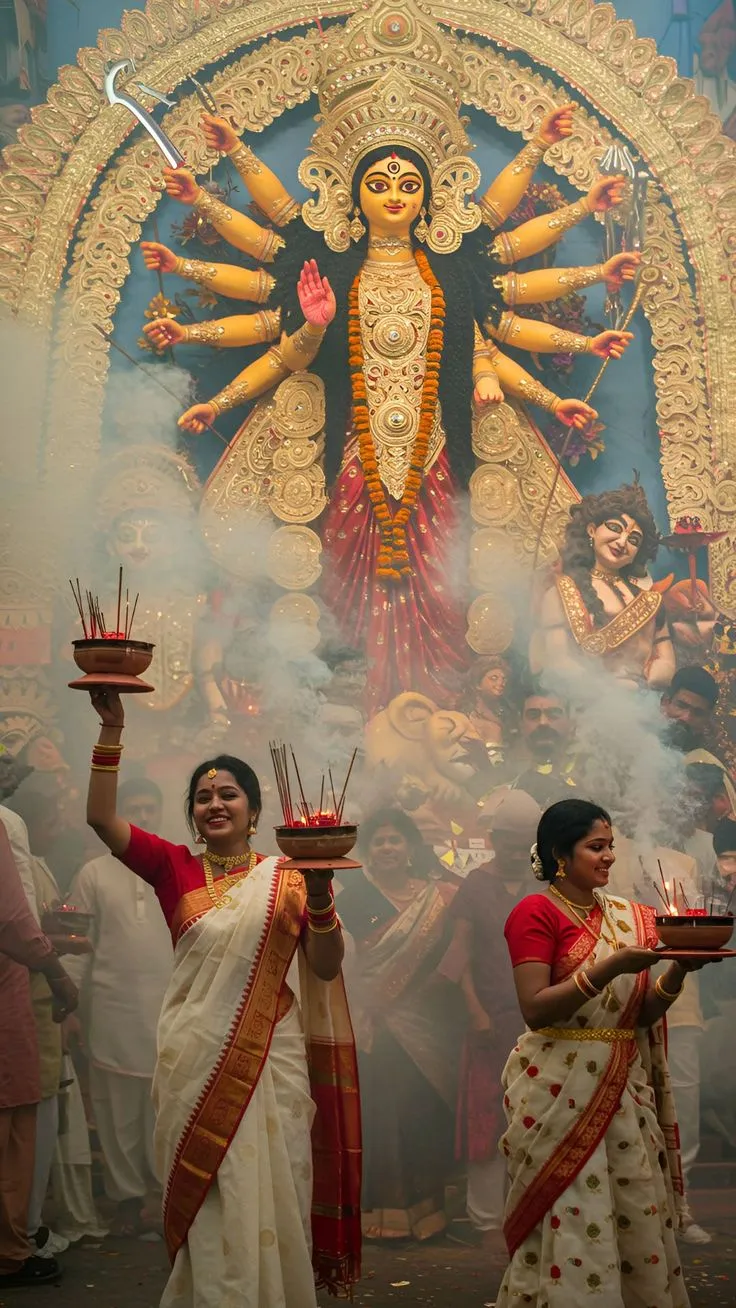
Goddess Durga illustrates the convergence of these historical strands with particular clarity. In her mythology she is a warrior who destroys the buffalo demon, a classic Shakta image of protective and martial power. In Bengali ritual and popular imagination she is also a daughter returning home, a mother figure welcomed with affection and elaborate domestic hospitality. The annual Durga Puja stages both dimensions: the cosmic victory and the intimate family reunion.
Similar dynamics appear in the worship of Kali, who can be terrifying in iconography yet is addressed with devotional intimacy in song and prayer. Local goddesses, once primarily concerned with specific dangers or needs, were increasingly interpreted through the broader categories of Shakti and, in some cases, brought into narrative or ritual relationship with Vaishnava figures. The outcome is a religious culture comfortable with multiplicity and with the coexistence of awe and tenderness.
Living Continuities
These historical layers continue to shape Hindu practice in Bengal today. Public goddess festivals remain major social and cultural events, drawing participation that crosses lines of class and, to some extent, community. Domestic rituals, pilgrimage to goddess temples and the recitation of Shakta texts persist alongside Vaishnava observances. Artistic traditions—image-making, song, theatre—still draw on the visual and emotional vocabulary formed by centuries of Shakta, Tantric and Bhakti interaction.
At the same time, Bengal’s Hindu traditions have never been static or isolated. They have absorbed influences from Buddhism in earlier periods, interacted with Islamic cultures, and responded to colonial and modern reform movements. The distinctiveness of the region lies not in purity or isolation but in the particular synthesis that emerged from these encounters.
A Regional Expression of a Larger Tradition
Hinduism in Bengal is best understood as a regional inflection of a wider civilisation rather than a separate religion. Shared deities, philosophical ideas and textual canons link it to practices elsewhere in the subcontinent. What sets it apart is the relative weight given to the goddess, the historical depth of Tantric influence, and the creative tension and exchange with Gaudiya Vaishnavism.
Ahead of Durga Puja each year, the public face of this synthesis becomes especially visible. Images of the goddess are installed, communities gather, and older mythological and ritual patterns are re-enacted in contemporary form. Behind the festivity lies a long history in which local deities became part of larger narratives, fierce power was joined to maternal care, and different paths to the divine found ways of coexisting. That history continues to give Hinduism in Bengal its characteristic texture and emotional range.
Read more – slangpilot.com