
Deadly flash floods that struck the Nepal-China border region on August 26 have raised difficult questions about the sequence of events and the sharing of early warnings. Voices in Nepal have asked whether a geological disaster dam on the Chinese side contributed to the destruction downstream and whether timely alerts could have reduced the loss of life. Beijing has now replied, rejecting those claims as false and calling for cooperation rather than accusation.
The Scale of the Disaster
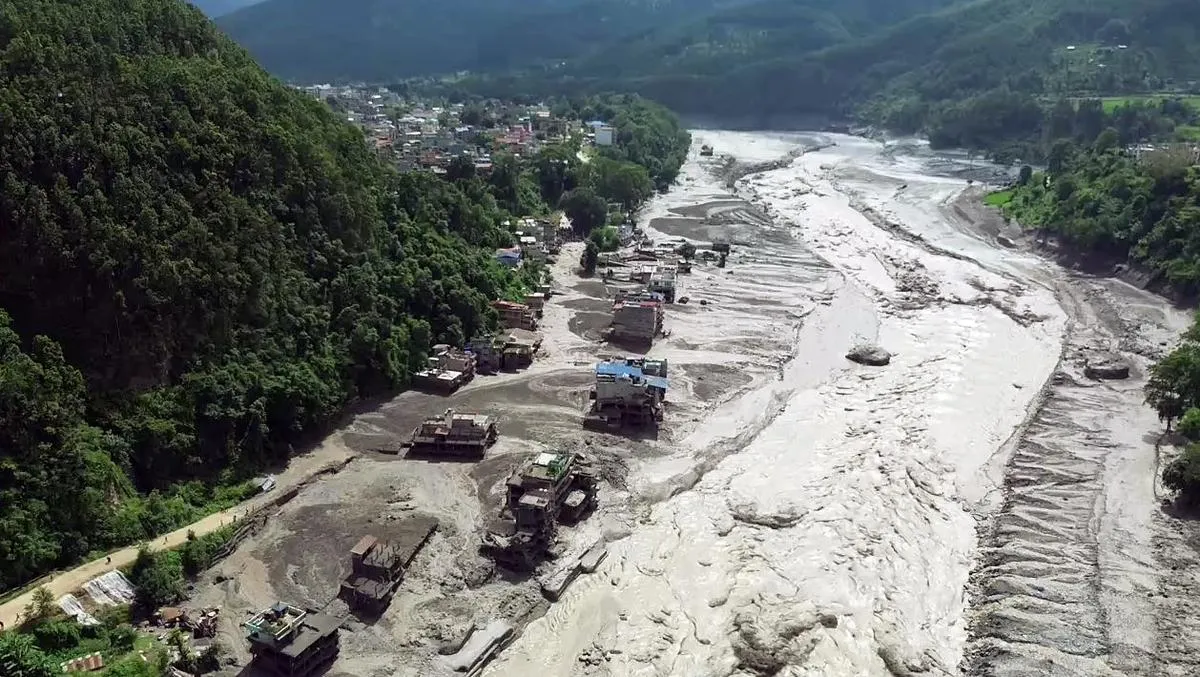
On the morning of August 26, a powerful surge of water, ice, rock and debris tore through parts of Nepal’s Rasuwa District and adjacent areas, including the Rasuwagadhi border zone. Settlements near the river were swept away, infrastructure was destroyed, and the death toll climbed rapidly into the hundreds, with large numbers of people still missing. The floods also affected the Chinese side of the border around Gyirong (Kerung) port in Tibet, where casualties and missing persons were reported and border facilities suffered heavy damage.
Nepal’s disaster management authority described the trigger as a chunk of snow and rock that broke off near a glacier zone roughly 20 kilometres northeast of the Rasuwagadhi crossing. The material either entered a glacial lake or temporarily blocked a river channel. When the blockage released, the resulting “glacier-inclusive flood” swept down the Lhende Khola into the Bhote Koshi river system, carrying enormous volumes of debris.
Questions Raised in Nepal
In the aftermath, some voices in Nepal pointed to the possibility that a natural dam formed by earlier geological activity on the Chinese side had collapsed, releasing a sudden and catastrophic volume of water. Others noted that Chinese border facilities at the Rasuwagadhi-Gyirong crossing and Gyirong port were themselves hit. They asked why, if those upstream installations were affected, warnings could not have been issued more quickly to communities further downstream in Nepal.
These questions reflect the practical difficulties of transboundary disasters in remote, high-altitude terrain. Information must cross both physical and administrative borders, and minutes can determine whether people have time to move to higher ground. The absence of rainfall at the time of the surge made the event even more unexpected for many residents going about their daily routines.
Beijing’s Formal Response
The Chinese Embassy in Nepal issued a clear statement rejecting the circulating claims. It labelled as “fake” the assertion that the collapse of a geological disaster dam on the Chinese side caused major losses to the Nepali side. It also rejected the charge that Beijing failed to issue an early warning and that this failure resulted in significant casualties in Nepal.
According to the embassy, an earthquake or earthquake-like glacier collapse occurred on the Nepali side on the morning of August 26. This event triggered huge mudslides that caused casualties and left people missing on both the Nepali and Chinese sides of the Gyirong-Rasuwagadhi border region. The statement concluded with the message that “accusation helps nothing” and “cooperation saves lives.”
Chinese officials have emphasised that the disaster affected both countries and that rescue and relief efforts are under way on their side of the border as well. Authorities have also flagged the risk of secondary hazards, including the possible formation or instability of temporary lakes upstream, and have increased monitoring accordingly.
Competing Accounts of the Trigger
Initial reports linked the floods to a modest earthquake in the region. Later assessments have refined that picture. Some scientific observations suggest the seismic signal may have been generated by the rapid collapse of ice and rock itself rather than by a conventional tectonic earthquake. Nepal’s preliminary analysis, based in part on satellite imagery, points to a glacial-rock slide along the border that sent debris into the river system.
The precise sequence—whether an earthquake triggered the collapse, or the collapse itself produced the recorded shaking—remains subject to further investigation. What is clear is that a large mass of ice, rock and water moved with great force through a narrow Himalayan valley, overwhelming communities and infrastructure on both sides of the frontier.
The Challenge of Transboundary Warning
High-mountain borders present unique difficulties for early warning. Communication networks can be disrupted by the same event that creates the hazard. Official channels between neighbouring countries may not operate at the speed required for flash floods that travel downstream in minutes. In this case, the fact that border facilities themselves were damaged complicated any rapid exchange of information.
China’s rejection of the failure-to-warn claim underscores its position that the event originated in a way that did not allow for the kind of advance notice some in Nepal expected. At the same time, the heavy losses on both sides illustrate the shared vulnerability of communities living along these rivers. Effective cooperation in monitoring glaciers, temporary lakes and seismic activity is widely recognised as essential for reducing future risk.
Humanitarian Priority and Longer-Term Lessons
As search and rescue operations continue, the immediate priority remains locating the missing and supporting survivors. Both countries have mobilised resources, and expressions of condolence and solidarity have been exchanged at official levels. The Chinese statement’s emphasis on cooperation over accusation reflects a desire to keep the focus on practical response rather than retrospective blame.
Looking further ahead, the disaster highlights the growing risks associated with changing conditions in the high Himalayas. Glacial instability, the formation and sudden release of temporary lakes, and the potential for cascading hazards are subjects of increasing scientific attention. Improved joint monitoring, shared data protocols and clearer channels for rapid warning across the border could help both sides prepare for similar events in the future.
The floods of August 26 have left deep scars in communities on both sides of the Nepal-China border. Questions about the exact trigger and the timing of information will continue to be examined by technical teams. Beijing’s reply has rejected claims of a Chinese geological disaster dam collapse and of a failure to warn. Whether those answers fully resolve public concerns in Nepal will depend on the transparency of subsequent investigations and on the quality of future cooperation in managing shared mountain hazards. For now, the focus remains on the human cost and on the practical work of recovery.
Read more – wisdomsuvichar.com