
Smart homes are evolving from collections of individual connected devices into intelligent, coordinated systems that anticipate needs and simplify daily routines. Advances in artificial intelligence, interoperability standards, energy management, and connected appliances are transforming residential living. These technologies deliver greater convenience, improved security, and measurable energy savings while reducing the complexity that once limited adoption.
The global smart home market continues to expand rapidly. Projections place its value around USD 230 billion in 2026, with strong growth expected through the early 2030s driven by rising demand for automation, remote control, safety features, and efficiency.
Artificial Intelligence Moves Homes from Reactive to Predictive
AI is shifting smart homes beyond simple command-and-response interactions. Modern systems learn household patterns—occupancy, preferred temperatures, lighting preferences, and daily schedules—and adjust environments proactively. Smart thermostats analyze routines and weather data to optimize heating and cooling, often delivering energy reductions of 8 to 20 percent or more depending on the system and usage.
Voice assistants are becoming more conversational and context-aware. Generative AI capabilities allow them to understand natural language requests, manage multiple devices in sequence, and offer recommendations. Instead of requiring precise commands for each light or appliance, users can describe outcomes such as preparing the home for evening or optimizing for lower energy costs. Platforms from major technology providers are integrating these more advanced assistants to coordinate lighting, climate, security, and entertainment as unified experiences.
Interoperability Through Standards Like Matter
One of the longstanding barriers to smart home adoption has been ecosystem fragmentation, where devices from different brands struggle to work together. The Matter standard addresses this by providing a common communication language that works across major platforms. Supported by leading companies, Matter enables local, secure connectivity over Wi-Fi, Ethernet, and Thread mesh networking.
Adoption of Matter-certified products continues to rise. Newer specifications expand support to additional device types, including cameras, video doorbells, garage door controllers, and enhanced energy management features. This progress allows homeowners to mix products from various manufacturers more freely, reducing the need for multiple apps and simplifying setup. Greater interoperability lowers friction and encourages broader use of connected technologies.
Energy Management Becomes Central
Rising energy costs and sustainability awareness have elevated energy management as a core smart home function. Intelligent systems now go beyond basic scheduling. They monitor real-time usage, predict demand, shift loads to lower-tariff periods, and integrate with solar generation, battery storage, and electric vehicle charging where available.
Smart thermostats, connected HVAC systems, intelligent lighting, and whole-home energy platforms give households visibility and control previously unavailable. Some systems coordinate appliances and climate control to minimize peak demand while maintaining comfort. These capabilities support both cost savings and reduced environmental impact, making energy intelligence one of the strongest drivers of new installations.
Security and Monitoring Enhance Peace of Mind
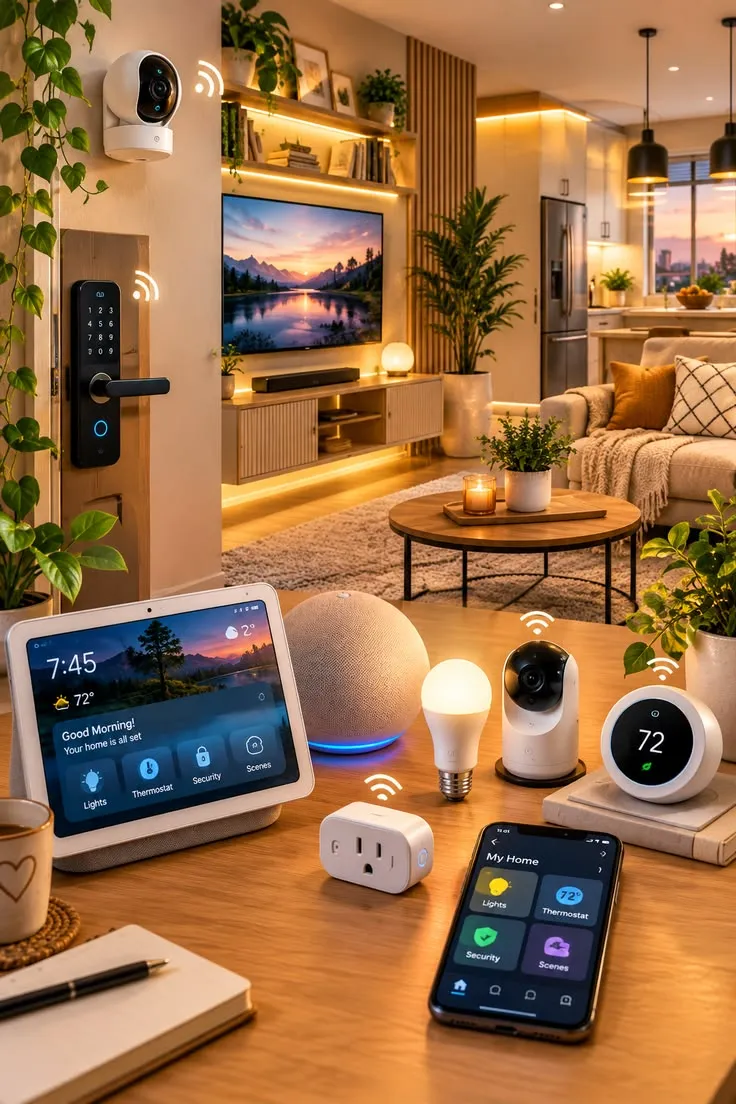
Connected security remains a primary reason many households adopt smart technology. Video doorbells, indoor and outdoor cameras, smart locks, motion sensors, and remote monitoring platforms allow real-time awareness of activity at home. AI-enhanced systems can distinguish between routine events and potential concerns, reducing false alerts and providing clearer notifications.
Remote access through mobile applications lets residents check status, grant temporary access, or receive alerts from anywhere. Integration with other home systems means security can coordinate with lighting or climate responses. As privacy-conscious processing and local data handling improve, confidence in these tools continues to grow.
Connected Appliances and Everyday Automation
Appliances are becoming active participants in the smart home ecosystem. Refrigerators, ovens, washing machines, robot vacuums, and other devices now share information and respond to broader household conditions. Some systems enable appliances to coordinate—for example, aligning cooking or cleaning cycles with energy availability or occupancy patterns.
Robotics and advanced sensors further expand capabilities. Cleaning devices that navigate more intelligently, sensors that monitor indoor environmental quality, and automated routines for lighting and window coverings reduce manual effort. Voice or app control unifies these functions, while predictive automation handles recurring tasks without constant user input.
Accessibility and Ease of Use
Improved natural language interfaces and simplified setup processes make smart homes more accessible across age groups and technical comfort levels. Conversational AI lowers the barrier to complex multi-device control. Standards that support easier pairing and local operation reduce dependence on constant cloud connectivity for basic functions.
Remote monitoring and automation also support independent living for older adults or those with mobility considerations by enabling safer, more responsive environments without requiring continuous manual oversight.
Looking Ahead
The trajectory of smart homes points toward greater orchestration. Rather than managing isolated devices, future systems will coordinate energy resources, appliances, security, comfort, and entertainment as a cohesive whole. AI agents capable of understanding context and acting on broader goals will sit above individual products, while open standards ensure flexibility in choosing hardware.
Challenges remain around privacy, cybersecurity, and ensuring reliable performance. Progress in edge processing, robust authentication, and transparent data practices continues to address these concerns. As costs decline and interoperability improves, these technologies move from optional upgrades toward mainstream residential features.
Smart home technologies are making everyday life easier by handling routine decisions, optimizing resources, enhancing safety, and responding intelligently to the people who live there. The combination of AI, standardized connectivity, energy intelligence, and connected devices creates environments that are more convenient, efficient, and responsive than traditional homes. Continued development in these areas promises even smoother integration of technology into daily living in the years ahead.
Read more – llookwhatmomfound.com