
Mahatma Gandhi and Lal Bahadur Shastri share more than a birth date. Both were born on 2 October, thirty-five years apart, and the ideas of the former left a deep and lasting imprint on the life and decisions of the latter. On the occasion of their common birth anniversary, it is instructive to examine two decisive junctures where Gandhi’s philosophy shaped Shastri—from his formative years in Varanasi to the final days of his prime ministership in Tashkent.
The First Encounter in Varanasi
Lal Bahadur Shastri first saw and heard Mahatma Gandhi as a boy of about eleven in Varanasi. Gandhi had come to speak at Banaras Hindu University. The audience included high British officials and Indian princes. In his address, Gandhi openly criticised British colonial oppression and the tendency of some Indian rulers to remain subservient to foreign authority.
The young Shastri was struck by the contrast between Gandhi’s gentle, almost frail appearance and the moral force of his words. He marvelled at how a man who seemed physically weak could command such attention and inspire such courage. That day, according to accounts of those who later recorded Shastri’s recollections, the boy realised that truth and justice could be more powerful than physical strength or official authority. The experience planted the seed of a lifelong admiration for Gandhian principles of non-violence, moral courage and public service.
The Turning Point of 1921
The second, and more decisive, encounter occurred in 1921 during the Non-Cooperation Movement. Gandhi returned to Varanasi and appealed to young people aged sixteen and above to withdraw from government-aided or government-controlled educational institutions and join the national struggle. Shastri was then a student at Harish Chandra High School, only months away from completing his studies.
He faced a difficult personal choice. Leaving school would mean sacrificing formal education and future prospects at a time when his family lived in modest circumstances. He sought his mother’s advice. She told him to reflect carefully on the right course of action and then hold firmly to whatever decision he reached. The next morning, Shastri withdrew his name from the school and enrolled as a volunteer with the Congress. From that day forward, he committed himself to the ethical principles of truth and non-violence that Gandhi had placed at the centre of the freedom movement.
This decision marked the beginning of Shastri’s active participation in the independence struggle. He later studied at the nationalist institution Kashi Vidyapith, where he earned the title “Shastri,” and took part in successive campaigns, enduring multiple terms of imprisonment. Throughout these years, he remained a consistent follower of Gandhian methods—emphasising simplicity, personal integrity and disciplined public service.
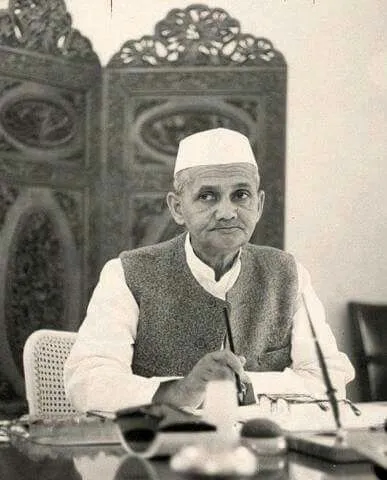
Gandhian Values in Public Life
After independence, Shastri’s career in government continued to reflect the same values. As a minister under Jawaharlal Nehru and later as Prime Minister, he was known for personal austerity, administrative integrity and a preference for quiet effectiveness over dramatic rhetoric. The slogan he popularised during the 1965 conflict with Pakistan—“Jai Jawan, Jai Kisan”—linked the defence of the nation with the dignity of the farmer, echoing Gandhi’s insistence that national strength rested on the well-being of ordinary people.
The Tashkent Decision as Tribute
The most explicit expression of Gandhi’s influence came at the end of Shastri’s life. After the 1965 India-Pakistan war, Soviet Premier Alexei Kosygin mediated peace talks in Tashkent. On 10 January 1966, Shastri signed the Tashkent Declaration, which provided for the withdrawal of forces to pre-war positions and a commitment to peaceful relations.
In the hours before the signing, Shastri spoke to his aides about the deeper meaning of the agreement. He described it as the greatest tribute he could pay to Mahatma Gandhi. On the morning of the signing, he told senior bureaucrat L.P. Singh that he had chosen the path of peaceful and friendly relations with Pakistan in order to keep faith with the most precious legacy the country had received from Gandhi. He argued that if relations remained strained and the possibility of renewed conflict persisted, India risked losing the unique heritage of non-violence, truth and human brotherhood that Gandhi had bequeathed. Peace, he believed, was essential if the nation was to preserve its moral soul.
Shastri died the following day, 11 January 1966, of a heart attack in Tashkent. His final major act as Prime Minister was thus framed explicitly as an affirmation of Gandhian values at a moment of high geopolitical tension.
A Continuous Thread
From the impressionable boy listening to Gandhi in Varanasi to the Prime Minister negotiating peace in Tashkent, a consistent thread runs through Shastri’s life. The early exposure to Gandhi’s moral courage shaped his decision to leave school and join the freedom movement. That commitment matured into a style of leadership marked by simplicity, integrity and a preference for reconciliation where possible. At the moment of greatest responsibility—ending a war and stabilising relations with a neighbour—Shastri returned consciously to the principles he had first absorbed as a child and youth.
The shared birth date of 2 October serves as a useful reminder of this connection. One leader articulated a philosophy of truth and non-violence; the other absorbed it early and sought to apply it, as far as circumstances allowed, in both the struggle for independence and the responsibilities of high office. The journey from Varanasi to Tashkent illustrates how ideas transmitted across generations can continue to guide decisions long after the original teacher is gone.
Read more – grammarthink.com